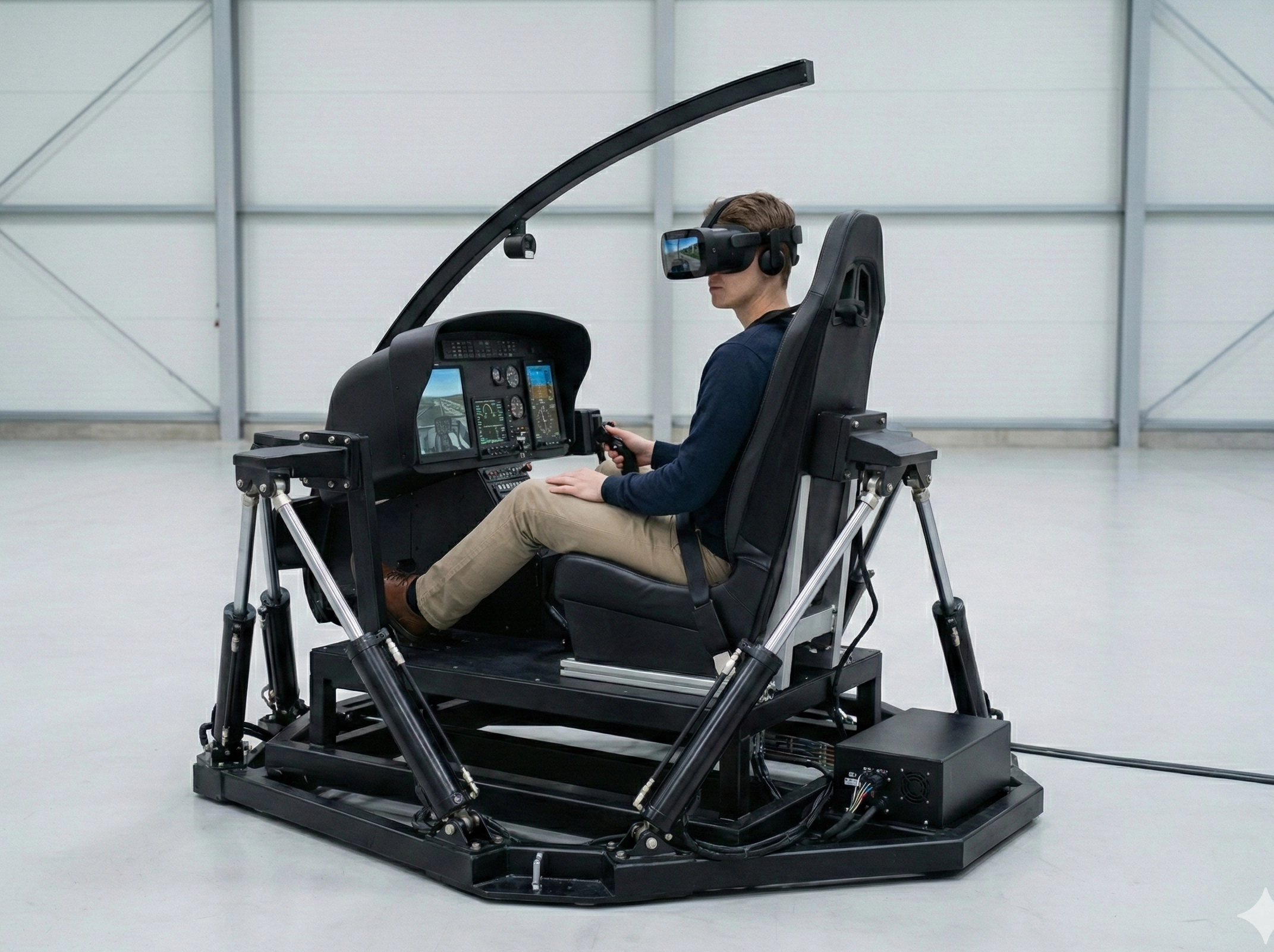
If you follow simulation trends, the hype surrounding Extended Reality (XR)—the umbrella term for Virtual, Augmented, and Mixed Reality—is deafening. It’s easy to believe the future of professional training is entirely worn on your face, replacing multimillion-dollar physical simulators with a closet full of headsets.
For C-suites and budget managers, the allure is obvious: lower costs, extreme portability, and infinite scalability.
At Southcoast Simulation, we embrace innovation daily. But we also know that chasing trends without analyzing training objectives is a recipe for expensive failure. For years, the simulation industry has wrestled with a massive trade-off when using headsets: you gain a limitless visual world, but you lose touch with the physical one.
However, recent breakthroughs in Mixed Reality (MR) and Passthrough technology are rapidly closing that gap, offering a balanced solution that was impossible just a few years ago.
To understand why the new tech is so important, we have to acknowledge where traditional Virtual Reality (VR) falls short in mission-critical training.
Standard VR is essentially a high-tech blindfold. You are immersed in a digital world, but cut off from your own body and immediate surroundings.
In high-stakes environments—like flying a helicopter, operating heavy machinery, or managing a complex control panel—this is a critical flaw. An operator relies on muscle memory and proprioception (the awareness of where their limbs and hands are in space). They need to glance down to tune a radio, flip a specific toggle switch by feel, and see their own hand doing it.
If they train by "pawing at air" with plastic controllers in traditional VR, that essential muscle memory is not being built. They learn the procedure, but not the physicality.
This is where the conversation has shifted dramatically. We are moving past simple VR into true Mixed Reality (MR).
Modern high-end headsets now feature sophisticated cameras that can pass a real-time video feed of the physical world into the headset. This allows for a groundbreaking training setup:
The trainee sits in a physical replica of a cockpit or control station. When they put on the headset, they see a photorealistic virtual world outside their "windows." But when they look down at their lap, they see their actual hands interacting with physical controls.
This approach, currently being pioneered in fields like rotorcraft (helicopter) simulation, is a massive leap forward because it merges visual immersion with tactile reality.
At Southcoast Simulation, we don't believe in choosing between the "old way" (heavy metal simulators) and the "new way" (headsets). We believe in choosing the right tool for the learning objective.
For pure familiarization, a simple VR headset is fantastic. For absolute fidelity in flight dynamics, full-motion heavy simulators remain king.
But for a vast middle ground of operational training, Mixed Reality is emerging as the ultimate balanced solution. It delivers the immersive visuals and scalable scenarios of digital engines, without sacrificing the crucial connection between hand, eye, and physical control. It’s no longer about virtual vs. physical; it’s about how seamlessly we can blend them.